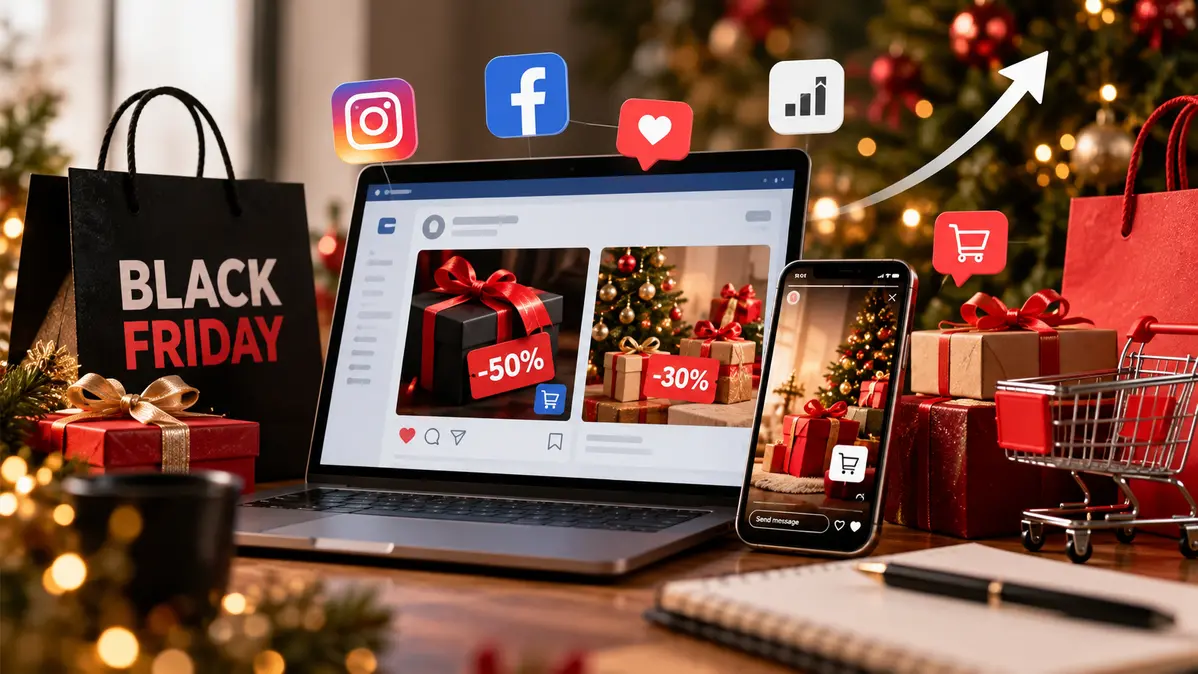
Black Friday and the Christmas shopping season are among the biggest sales opportunities of the year. And the numbers speak for themselves.
On Black Friday 2025 alone, US consumers spent approximately $11.8 billion online, while online sales throughout the holiday season, from November 1 to December 31, reached a record $257.8 billion. For the 2026 holiday season, the National Retail Federation forecasts that total US retail sales in November and December will exceed $1 trillion.
These impressive figures highlight something important for businesses: during the holiday season, consumers aren't just more willing to spend. They're actively searching for deals, comparing offers, and planning their purchases.
But there's a catch. Almost every business is advertising, and competition is fierce.
Social media feeds become flooded with messages like "50% OFF," "75% OFF," "Today Only," "Limited Stock," and "The Biggest Sale of the Year."
With so many brands competing for attention, simply announcing another discount is no longer enough.
That's why a successful holiday campaign doesn't start with the question:
"What should our Black Friday banner look like?"
It starts with something far more important:
"Why should customers choose us over everyone else?"
The answer lies in combining a compelling offer with the right audience, persuasive messaging, engaging ad creatives, a well-prepared website, and a carefully planned advertising strategy.
1. Start With the Offer, Not the Ads
One of the most common mistakes businesses make is designing an eye-catching Black Friday banner before deciding what they're actually going to promote.
The smarter approach is to work the other way around.
Before launching your campaign, ask yourself a few important questions:
What are we trying to achieve? More sales? New customers? A higher average order value? Increased sales of a particular product category? More repeat purchases from existing customers?
Then comes the next question:
What would motivate someone to buy right now?
The answer doesn't always have to be a bigger discount.
A compelling promotion could include a percentage discount, a fixed amount off, a free gift with purchase, free shipping, an exclusive bundle, a gift for orders above a certain value, or a limited-time offer.
For example, instead of simply advertising:
"20% Off This Black Friday"
You could offer:
"20% Off + Free Shipping"
Or:
"Choose a Gift Set and Save €25."
The difference is that customers see a specific, tangible benefit rather than just another percentage in their social media feed.
2. Don't Wait Until Black Friday to Launch Your Campaign
If your first ad goes live during Black Friday week, you may already be too late.
In recent years, Black Friday has evolved from a single shopping day into an entire month of promotions.
Competition for consumer attention is intense, and brands are launching their offers earlier than ever.
If your campaign starts too late, potential customers may have already spent their shopping budgets on deals offered by your competitors in early November.
That's why a successful promotional campaign needs to start well before the actual sale.
During the lead-up period, you can introduce your products, highlight their benefits, reach new audiences, and build interest in your brand.
You can also start building valuable remarketing audiences consisting of people who have visited your website, viewed products, watched your videos, or engaged with your content.
When your main promotion finally begins, you're no longer advertising exclusively to people who have never heard of your business.
A simple campaign structure might look like this:
Awareness & Warm-Up → Main Promotion → Last-Chance Offers → Christmas Campaign
This approach allows you to build momentum throughout the entire holiday shopping season instead of relying on a single day.
It's also worth remembering that new Meta advertising campaigns need time to complete their initial learning phase and optimize delivery.
Launching your ads at the last minute leaves little room for testing, learning, and improving performance.
3. Make Sure Your Discounts Are Both Attractive and Compliant
When planning a Black Friday campaign, there's another important consideration that shouldn't be left entirely to the marketing team: the legal requirements surrounding promotional pricing.
Under the rules applicable in Bulgaria, which implement the relevant EU consumer protection framework, the reference price used when announcing a price reduction is generally the lowest price applied to the product during a period of at least 30 days before the reduction.
The purpose is simple: customers should see genuine discounts rather than percentages calculated against artificially inflated prices.
Let's look at an example.
Suppose a product was priced at €100 before Black Friday and is reduced to €80 during the promotion.
That's a genuine 20% discount.
Now imagine you want to offer a further 20% discount during your Christmas campaign.
In the example of a new, separate promotion following Black Friday, the reference price would be the lowest price during the preceding 30 days — €80, rather than the original €100.
A further 20% reduction from €80 would bring the new promotional price to €64.
However, the precise rules can depend on how successive or progressively increasing reductions are structured, so businesses should verify the applicable requirements before launching their campaigns.
There's another important consideration: promotional periods cannot continue indefinitely.
According to guidance from Bulgaria's Commission for Consumer Protection, the duration of an announced price reduction must be clearly defined and generally cannot exceed one month.
This means that campaigns advertised as "Black Friday All Season" or permanent "special discounts" require careful planning.
The same applies to promotional claims such as:
"Up to 70% Off"
Just because a few products carry a 70% discount doesn't mean your advertising can create the impression that every featured product is discounted by that amount.
In 2026, Bulgaria's Commission for Consumer Protection reported an unfair commercial practice involving a Black Friday campaign advertising discounts of "up to 70%." The advertising suggested that the displayed products were discounted, even though some were not actually being offered at reduced prices.
The lesson is clear: your ad visuals, promotional copy, and website pricing must tell the same story.
A bold discount can attract attention. A misleading one can lead to dissatisfied customers and potential regulatory consequences.
4. Don't Show the Same Ads to Everyone
Imagine two potential customers.
The first has never heard of your brand.
The second visited your website yesterday, viewed a specific product, added it to their cart, but didn't complete the purchase.
Should they see exactly the same ad?
Probably not.
Someone discovering your brand for the first time needs a reason to become interested.
You might introduce the product's benefits, demonstrate how it works, highlight customer reviews, or use an engaging video to capture their attention.
Someone who has already viewed the product doesn't need the same introduction.
A more direct message might work better:
"Still Thinking It Over? Our Black Friday Deal Ends Tonight."
Existing customers, on the other hand, might respond well to complementary products, exclusive bundles, or special Christmas offers.
This is where remarketing becomes an essential part of your advertising strategy.
For example, someone who browsed your website in October without making a purchase could be reached again in November with a compelling reason to return — the same product, now available at a better price.
By tailoring your message to different audiences and stages of the buying journey, you can make your advertising more relevant and effective.
5. Don't Let Your Website Ruin a Great Campaign
You can have an irresistible offer, beautifully designed ads, and a well-optimized advertising campaign — and still end up with disappointing results.
Sometimes, the problem starts after the click.
Black Friday shoppers aren't known for their patience.
If your website loads slowly, a discount code doesn't work, a product turns out to be out of stock, or checkout is unnecessarily complicated, customers can easily move on to a competitor.
Before launching your campaign, test the entire customer journey:
Ad Click → Product Page → Shopping Cart → Checkout → Order Confirmation
Make sure the process is smooth, especially on mobile devices.
Accurate conversion tracking is just as important.
Tools such as Meta Pixel, Conversions API, and Google Analytics, together with your advertising platforms, should correctly track key customer actions, including product views, add-to-cart events, and completed purchases.
Without reliable tracking, you may have plenty of data but very little useful insight into whether your advertising is actually delivering results.
6. Black Friday Is Over. Your Campaign Doesn't Have to Be.
One of the biggest missed opportunities is switching off all advertising immediately after Black Friday.
Because what comes next?
Another major shopping season: Christmas.
And by this point, you've already built something valuable — an audience.
You have people who visited your website, explored your products, engaged with your ads, completed purchases, or came close to buying.
Instead of starting from scratch in December, you can continue the conversation with a new message focused on Christmas shopping and gift ideas.
Your existing audiences can be introduced to gift sets, complementary products, seasonal offers, and other relevant promotions.
This turns Black Friday from a standalone sales event into the first phase of a broader holiday marketing strategy.
7. Set Clear Goals and Measure What Matters
Before planning your advertising campaigns, it's essential to define what success actually looks like.
Vague goals such as "We want more sales" aren't enough.
Your objectives should be specific, measurable, and tied to real business outcomes.
For example:
- Increase profit by 30%.
- Grow website traffic by 40%.
- Improve conversions by 25%.
The next step is deciding which key performance indicators (KPIs) matter most to your business.
Are clicks and engagement your primary goals, or are conversions and sales revenue more important?
For most e-commerce businesses running holiday promotions, revenue, profitability, and conversion performance will be more meaningful than the number of likes an ad receives. It's also important to choose the right comparison period.
Instead of comparing your Black Friday performance with the previous month, use the equivalent promotional period from the previous year. This provides a more meaningful benchmark and helps you evaluate whether your current campaign has actually improved.
Finally, always compare the results reported by your advertising platforms with your actual store sales data.
A successful ad isn't the one that generates the most reactions. It's the one that achieves the business objective it was created for.
A Successful Holiday Campaign Is a Strategy, Not Just a Discount
Black Friday and Christmas offer tremendous opportunities for businesses.
But because everyone wants to take advantage of the holiday shopping season, competition is intense.
You don't necessarily need to offer the biggest discount.
What you need is a compelling offer, the right message, a relevant audience, a variety of engaging ad formats, a website that's ready to convert visitors into customers, and a clear strategy for what happens before, during, and after the promotion.
Because at the end of the day, customers aren't buying a discount percentage.
They're buying a product they want, at a price they consider worthwhile, from a business they trust.
Planning a Black Friday or Christmas Marketing Campaign?
At Impulse Media, we can help you develop a comprehensive holiday marketing strategy — from compelling advertising messages and engaging social media content to managing performance-driven campaigns across Meta and Google.
Don't wait until the sale begins to start preparing.
Plan ahead, stand out from the competition, and turn holiday shopping interest into real business results.
Author: Marina Zhelyazkova